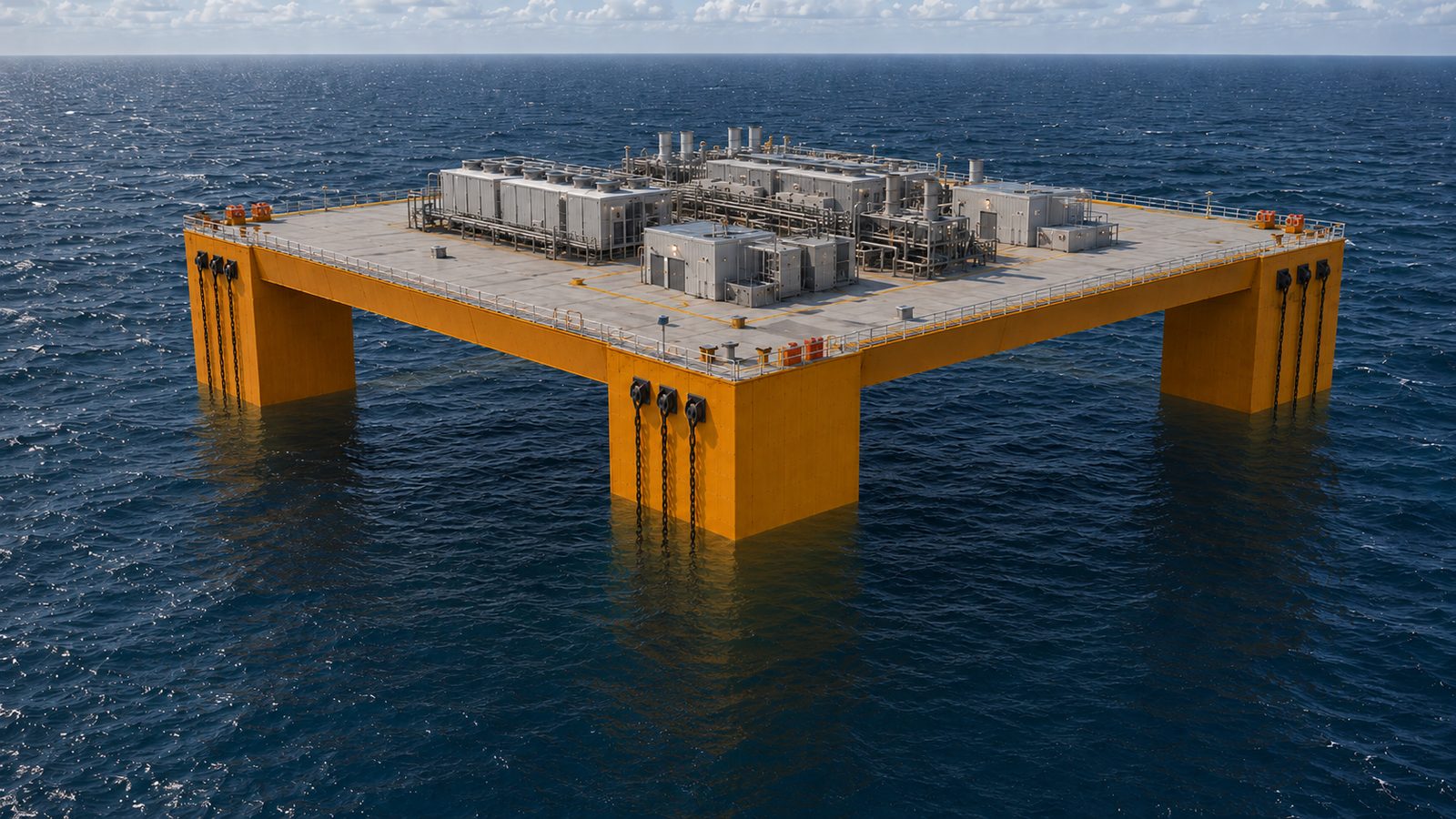
The asset
A bare hull. The structural platform, station-keeping provisions, basic marine systems and a defined set of interface points. Everything above the interface is yours.
Reference design
| Type | Multi-Purpose Semi-Submersible — continuous submerged square ring pontoon, four square corner columns, full flat structural deck |
| Plan dimensions | 90 m × 90 m |
| Operating draft | 27.5 m |
| Deck top elevation | 56.25 m |
| Air gap to deck underside | Sized so the deck sits clear above the operating waterline |
| Deck payload envelope | 30,000 t |
| Construction | Flat stiffened plate and box-girder throughout. No diagonal bracing, no tubular nodes |
| Station keeping | Moored. Fairlead and chain locker foundations at fixed locations, sized to a defined load envelope |
| Ballast | Compartmented ring pontoon plus column tanks. Sequenced pontoon first, then column tanks from the bottom upward |
| Riser capability | Suitable for steel catenary risers where the application calls for them |
| Structural life | 40 years |
Reference design figures. Site-specific metocean qualification is confirmed per deployment.
The interface
A leasable hull only works if the things that govern qualification are frozen, and the things that govern your business are not.
Risk position
Ring-pontoon, four-column, deep-draft platforms are the standard deepwater production host in operation today, carrying hydrocarbons in the most demanding motion environments offshore.
Class societies have approved this hull form repeatedly for other owners. Unit certification proceeds on build in the normal way, against a form the societies already know.
Lloyd's Register pre-certification, an independent hazard review that identified no inherent safety weakness, and physical model testing of structure and hydrodynamics at the University of Glasgow.
Primary documentation is released to qualified counterparties under NDA. Site-specific qualification and unit class certification are normal build-stage activities, not open questions about the architecture.